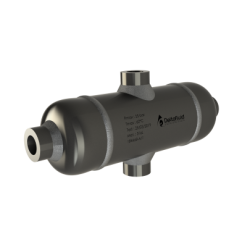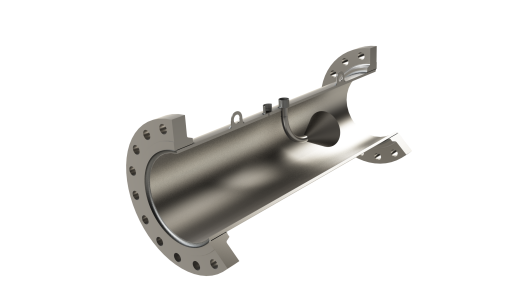
Suitable for short straight lengths and low flow rates
BENEFITS:
- short straight lengths: weight and space-saving solution
- cost-effective measurement solution: low installation cost and maintenance free
- robust and reliable product: very long life-time, no drift over time
GENERAL DATA:
- Standards: ISO 5167-1 & 5.
- Solder (BW) or flanged connection
- Material: Standard: carbon steel, stainless, others according to your application.
- Fluid: liquid, gas, steam.
- Diameter of pipes: from 50 to 500 mm.
- Accuracy: 5% of max flow.
- Repeatability of the measure: 0.1%
The cone meter is optimal for flow measurement when a space-saving solution is needed: upstream and downstream required straight lengths are reduced. Which also makes it a device often suitable for renovation.
It is designed and manufactured according to the ISO 5167-5 standard.
The noted measurement accuracy is 5% of the maximum flow rate. Calibration of the device is recommended in order to increase the measurement precision and know the uncertainty of the discharge coefficient.
| ISO 5167-1&5 | ||
|---|---|---|
| ReD | Reynolds number in pipework | 8.104 ≤ ReD ≤ 1,2.107 |
| D | Pipe interior diameter | 50 mm ≤ D ≤ 500 mm |
| β* | dc,cone diameter where its circumference is greatest | 0,45 ≤ β ≤ 0,75(1) |
| Ra | Cone surface roughness | Ra ≤ 5.10⁴.dc |
| R1 | Radius at the max circumference of the cone | R1 < 0,000 5.dc ou < 0,2 mm |
| L | Distance between upstream and downstream pressure | 50 mm ≤ L ≤ 2.D |
* formula β
(1) for β> 0.75, the measuring cone must be calibrated.
If you do not find the answer you are looking for, please contact us either by phone at +33 (0)5.59.30.85.20 or via the contact form. We will respond as soon as possible.
A cone flowmeter according to ISO 5167-5 is used in cases where the size of the measuring device is critical: it requires short straight lengths compared other differential pressure primary elements (sharp-edge orifice plates for example).
It is therefore an attractive option for retrofitting: there is no need to rework the pipework, as the measuring cone can be easily installed in place of another flow meter. It is also perfectly suited to measuring the flow of fluids such as gas, liquid or steam.
The measuring cone or v-cone ® is an aerodynamically shaped cone inserted into the pipework and positioned in the centre of the fluid flow; it is, in effect, surrounded by the fluid on all sides. In addition to its flow measurement function, it is designed to act as a flow straightener. It reduces turbulence and ensures a stable fluid flow profile. This means there is no longer any need for long straight sections to stabilise the flow prior to measurement. Accurate measurement is therefore possible with the measuring cone.
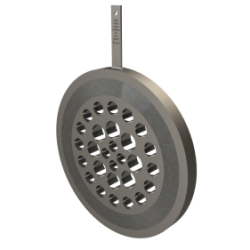
Another differential pressure measurement device can also be used with short straight runs: the conditioning orifice plate, acts – as its name suggests – as a flow conditioner.
Where space is limited, both devices can therefore be used: the measuring cone or the conditionning orifice plate. The choice between the two technologies then depends on the type and characteristics of the fluid.